The LLM Catch-22: User Trust in AI Depends on Sources That Don’t Get Clicks
Published: 11 Sept 2026
Without publisher content, artificial intelligence is not very intelligent at all. While many publishers may look at the declines in referral traffic since the proliferation of AI and feel despair, we must remember the value that we have. It is our intellectual property that “teaches” the same LLMs that are now powering interfaces that syphon our traffic.
It is not only learning materials that publishers provide. The presence of a trusted publisher brand rubs off on the AI interface that sources it, significantly increasing the trust users place in its responses.
In this final of three articles sharing findings from the AOP’s newly launched ‘Artificial Intelligence Publisher Impact Study’, we’re exploring the trust paradox at the heart of the unequal value exchange between AI platforms and publishers.
Trust in the source equals trust in the AI citing it
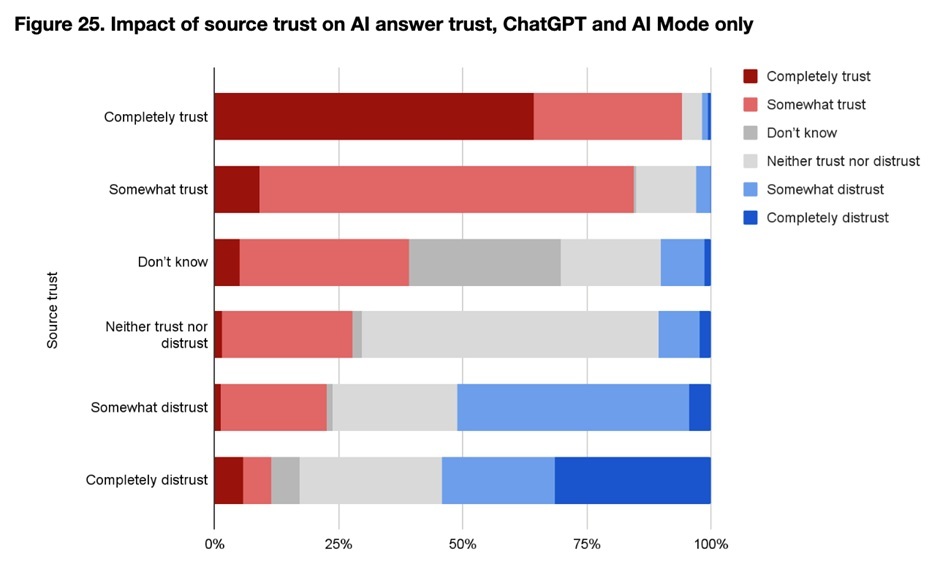
A user’s perception of a media brand cited within an AI response determines whether they trust the answer overall. In a nationally representative UK study conducted by Ipsos, we found a direct correlation between trust in the source and the trust in an AI answer: a completely trusted source results in more than 90% trust in the answer, while a completely distrusted source results in trust of around 10%.
Even neutral is not good enough for AI users. A source that is neither trusted nor distrusted returns an average trust in the AI answer of around 25%. Clearly, premium publisher citations materially lift the perceived reliability of the entire AI interface.
The good news for premium publishers is that trust in their brand also increases an AI user’s propensity to click through to the source. Almost half of users who either completely or somewhat trust a source will click on at least one link in the response and, unsurprisingly, completely distrusted sources are hardly clicked at all.
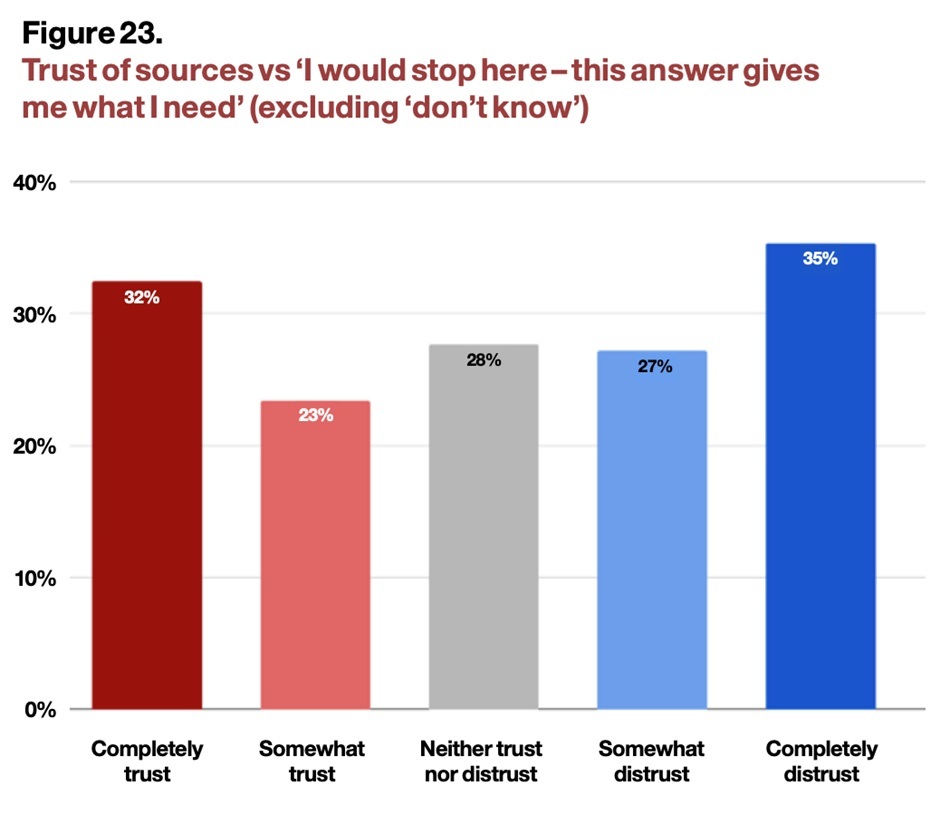
However, high trust also increases the frequency of “stop here” behaviours (which we cover in detail in our prior article), where the user retrieves information from an AI interface and does not interact further. Reported willingness to stop is highest among those who completely distrust the sources (35%) as well as those who completely trust (32%).
The symbiotic relationship between AI and publishers
LLMs are optimised to generate plausible-sounding answers, and fundamentally do not understand what is and is not true as they operate purely on probability. By their nature, LLMs will inevitably introduce errors. Years-deep into the proliferation of AI interfaces, “hallucinations” (a humanising term for what in any other software is called an error) remain a regular occurrence.
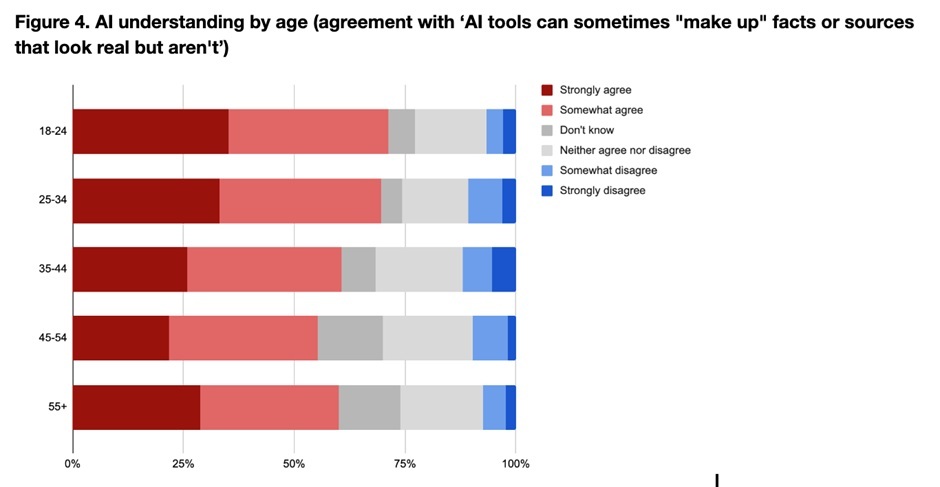
While most respondents in our study were aware of this fact, 37% did not realise that AI tools can sometimes fabricate information or sources, peaking at around 45% of 45-54-year-olds. This is a worryingly high figure considering AI platforms are becoming a go-to information source for an increasing proportion of the UK public.
The only way AI platforms can stave off misinformation is through constant input of professional human work. Platforms like OpenAI are actively signing and showcasing licensing deals with premium publishers because they are acutely aware of their desperate need for reliable, real-time reporting to provide an anchor of truth for their error-prone conversational interfaces.
This gives AI companies an opportunity to really show their cards when it comes to supporting the media industry. If premium publishers walk away or block access to their content, the utility of AI tools degrades immediately.
Meanwhile, UK publishers are gaining regulatory levers such as the CMA’s ruling that Google must let publishers opt out of AI overviews in June 2026. We are at a potential turning point where tech businesses can show their support for their own supply chain by ensuring the ecosystem they are disrupting can be maintained.
Simon Collis, SVP of games, technology and audience at Future, put it beautifully at a recent AOP CRUNCH: “We’re so used to talking and thinking about tech giants like we’re just a speck on their shoe, they’re so huge. And actually, in this particular conversation, you know what? It’s not as easy to substitute our work as you think it is. We are more important than you think.”
The information ecosystem is built on real work that must be compensated
The genie cannot be put back in the bottle. The toothpaste cannot be put back in the tube. Whatever your preferred idiom, AI interfaces have proven themselves to be convenient, accessible, and popular. Love them or loathe them, they are now part of the fabric of the internet.
No matter how sophisticated, AI interfaces have inherent risks that can only be mitigated (though not solved) through the quality of their sourcing. The information ecosystem depends on professional, human work which must be paid for, and is supported by complex organisations that need to be able to keep the lights on.
Some publishers have secured materially consequential agreements with AI companies to do exactly that. However, it’s hard not to get the sense that we are victims of a strategy of divide and conquer. While it’s understandable that publishers keep the details of their licensing deals behind closed doors, this limits our ability to take collective action and establish a baseline for fair compensation for the access and reproduction of our intellectual property.
In the meantime, do not expect declining referral traffic to return. As we covered in our first article in this series, publishers must double down on content types and categories that are least vulnerable to AI substitution and most capable of driving repeat audience engagement. In short, audiences continue to seek content with a point of view, but are flocking to AI for quick answers.
We cannot relegate generations’ worth of authoritative work and brand reputations to being mere LLM feedstock. While it can feel like AI platforms are attempting to replace publishers whole cloth, in the long term they cannot survive without us. The current status quo is not sustainable for either side.
The more both parties kick the can down the road in finding a solution, the more damage is done to the information ecosystem. Together, we must build a new online economy where reporters, journalists, critics, commentators, and creators of all stripes can afford to continue their vital work. Publishers are doing their part, and now it’s time for the tech companies driving AI in search to do theirs.
This article was originally published in Press Gazette on 27th July 2026. See the piece here.
Categories: AOP News | Research