AOP CRUNCH: Driving growth through branded content
Published: 07 Apr 2025
Author:
Richard Reeves
Spring hasn’t sprung until CRUNCH takes place.
The Association of Online Publishers (AOP) recently held its first CRUNCH event of the year, and it was suitably optimistic for a change of season. The day’s discussions centred on branded content – a fertile patch of fresh growth in the otherwise dry and cracked ad spend soil.
“What we are seeing, in what is otherwise a very, very difficult business right now, is that branded content is one of the best places to be,” said Jesper Laursen, Founder of The Native Advertising Institute, who opened the event. “Even if advertising revenues are going down on many publishers’ sites, we're seeing branded content going up. We’re doing a research piece on it, and we're looking at index numbers of 105 to 130, even 140 sometimes.”
Beyond revenues, there are many reasons to cultivate more direct relationships between the sell-side and buy-side: less dependency on erratic programmatic spend; reduced reliance on big tech’s various algorithms; a restoration of the advertising model that kept printing presses humming. Most of all, it’s about creating a more sustainable and engaging digital publishing ecosystem.
We were joined by experts from leading publishers, agencies, and tech partners to discuss all the above, and more.
How New York Times Advertising brings T Brand Studio’s editorial prestige to big-name brands
The New York Times needs no introduction, but T Brand Studio might. As the content studio within New York Times Advertising, T Brand Studio is the creative hub for brand storytelling that spans The New York Times’ many channels, from its print and digital mainstays to emergent channels such as apps and podcasts.
Raquel Bubar, Managing Director at T Brand Studio International, spoke of how their campaigns eschew hard sells for editorially driven content that has real value for its audiences, regardless of the brand association, often tied to existing columns or series within The New York Times.
For example, Bubar shared how the 25th anniversary of Modern Love — a weekly relationship column that had expanded across books, podcasts, and TV — was the perfect opportunity to secure a brand collaboration with Cartier, which was celebrating an anniversary of its own with 100 years of its Trinity ring. The result was 100 short, deeply personal anecdotes about love that were inserted across Modern Love content, bookended by Cartier branding.
Then, in collaboration with L’Oréal Groupe, T Brand Studio took on the lofty goal of reframing beauty content as a soft subject to one that spans culture, technology, politics, sport, and all other domains of human life. A new content vertical, Face Value, was launched with exclusive L’Oréal Groupe branding, hosting high-brow beauty-related articles. Simultaneously, T Brand Studio launched the six-episode, L’Oréal-sponsored This is Not a Beauty Podcast, hosted by Isabella Rossellini and featuring interviews with beauty professionals from around the world, from Michelle Obama’s makeup artist to the barber of the England football team.
While few publishers can bring Isabella Rossellini into their branded content campaigns, all can benefit from Bubar’s advice for including the T Brand editorial team not just in the creative process, but the sales process as well:
“In almost every idea — when we think the client is interested in content or storytelling of some kind — we bring a creative director or an editor/journalist from T Brand Studio into the conversation. Creatives are there to tell stories, so it's much more of a fun conversation to have with clients when you’ve got those people involved. So [we involve creatives] right from the beginning.”
“Culture is our KPI” — inside Condé Nast’s moment-making brand campaigns
With 28 different titles across 37 markets, Condé Nast offers brands a unique opportunity to be in tune with the cultural pulse. Nico Sarti, Global VP of Creative Strategy at Condé Nast, shared how commercial strategies are steered by the insights of the company’s editorial teams, and how alignment between the two provides authentic, wide-reaching brand moments that can benefit from months of planning.
“Our editorial team comes to us with this amazing culture calendar every year,” said Sarti. “It's a really sought after moment for us, for the revenue team, because it means that we can map out how we can connect with a media agency or a comms agency, and explain these are the 10 things that we believe will deliver a little shift in culture, when it comes to lifestyle, when it comes to IT, when it comes to technology, when it comes to AI.”
“Our internal mantra at Condé Nast is ‘culture is our KPI.’ So, we need to be able to drop a conversation in a particular platform and deliver culture. Whether it’s the cover of GQ with Rihanna and A$AP Rocky, or having a series of covers featuring female athletes across every title that Condé Nast can produce ahead of the Olympics. Or — I don't know if you noticed it — but a few months ago the entire cast of White Lotus started popping up in every single one of our IPs, whether it was Architectural Digest’s Open Door, or Vogue’s 73 Questions.”
As an example, Sarti discussed Nike, which was pivoting back to brand campaigns after years of prioritising programmatic performance channels had eroded its cultural cachet. Seeing an opportunity with the build-up to the 2024 Paris Olympics, Nike collaborated with Condé Nast to leverage the aesthetics and prestige of Vogue in a series of brand partnerships that explored the intersection of fashion and sport.
In the omnichannel campaign that followed — which was kicked off with a dedicated Nike segment in the Vogue World livestreamed sports-themed runway event on the streets of Paris — Vogue’s house style was married with Nike’s products and athletes to position the brand alongside the likes of Balenciaga and Louis Vuitton. Thanks to Condé Nast, a sports brand could share the runway with the great European fashion houses.
Connecting Tesco Finest to the Guardian’s Feast foodies
With 41% of its audience identifying as foodies, the Guardian was the ideal publisher for a partnership with a premium supermarket brand. When it expanded its food-focused vertical Feast with a new app in 2024, Tesco Finest (with EssenceMediacom) secured exclusive residency throughout the launch period in part of a six-month campaign that spanned the entirety of the Feast brand across digital, print, newsletters, social media, and podcasts.
Lauren Franklin, Commercial Features Director at the Guardian, detailed some of the technological innovations that helped the campaign stand out with audience-friendly features. Shoppable recipes on the website allowed readers to fill a Tesco shopping basket with all ingredients in one click, while the Feast app itself simply wouldn’t have been possible without AI to help format and structure the Guardian’s archive of 30,000-plus recipes.
The result was the Guardian’s biggest campaign of the year and impressive results for Tesco Finest, which saw a 15.5% increase in sales during Q3 and Christmas trading. Franklin attributed the success of the Guardian’s brand partnerships to the replication of editorial standards and structure in its commercial wing.
“The branded content part of Guardian Advertising, Guardian Labs, was set up as a commercial features desk - mirroring how our editorial features desks work,” said Franklin. “Our team of commissioning editors is made up of people from diverse backgrounds — from sport, lifestyle journalism, news, finance — who all give our articles the editorial treatment, but putting brands at the heart of it.”
“The Tesco Finest campaign, like any, had a dedicated editor who worked directly with cook Esther Clark to curate these really gorgeous recipes — which were obviously completely exclusive — because we really do believe at the Guardian that we can deliver amazing content that people love to read without ever shying away from the fact that it's clearly labelled as advertising … We love advertising, and so do our readers: our page views and dwell times really do speak for themselves.”
A foolproof framework for selling branded content to advertisers
Tom Gunter, Co-Founder and Product Solutions Director at Avid Collective, sits between publishers and brands, connecting the latter to the network of more than 150 publishers reached by his collective with solutions designed specifically to facilitate branded content campaigns. Much of Gunter’s work involves selling brands — from local to national and international — on the benefits of branded content, the framework for which he shared with the CRUNCH audience.
Gunter’s framework highlights five benefits of branded content to make it easily digestible for Avid Collective’s salespeople, and those they’re selling to. If a brand’s objectives tick three out of five boxes, they’re ready for a branded content campaign.
First is attention, a metric that is usually measured in seconds, but in branded content can be stretched out to minutes or even hours. Then there’s trust; audiences expect publishers they follow to have vetted their brand partners. Next is relevance, as brands can guarantee their placements align with appropriate content, which is far from guaranteed on other channels, particularly programmatic ones.
Another benefit is rich content, as publishers can — as evidenced above — deploy branded campaigns across multiple forms of media with editorially-driven, informative, and valuable content. Finally, positive perceptions: association with a quality publisher allows brands to piggyback off their reputation, with audiences looking at brands that support their favourite publishers in a better light than social media or generic display advertising.
100 titles or 2? How publisher scale affects branded content strategy
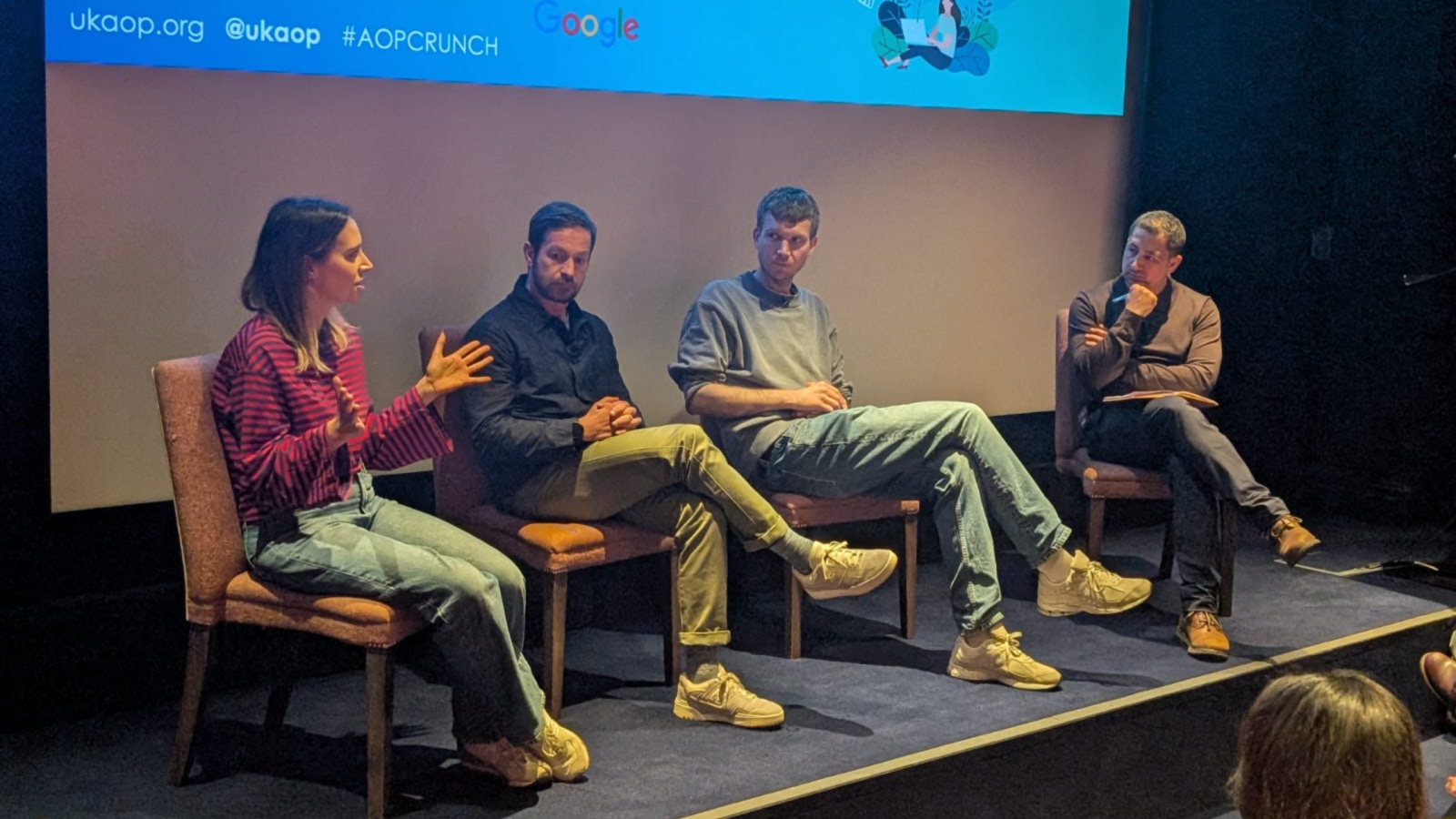
In the first panel of the day, Arif Durrani, Global Content Director at Reuters Plus and host of the event, sat down with Liz Percy-Robb, Head of Digital Commercial at National World and Arianna Chatzidakis, Creative Content Director at HELLO! Magazine.
With more than 100 regional titles from across the UK in its armoury, National World had to build a brand studio that was scalable and profitable both for brands that want to reach across its network to SMEs that only want to target their local area. Rather than rely solely on sales briefs, every customer of National World gets a phone call with a commercial editor who has the writing experience to be able to discuss the storytelling potential of their campaign and step out of the comfort zone of simply sending out a press release.
The larger the campaign, the more editorial expertise National World can throw at it:
“A lot of our national brands might have regional budgets to spend, so we can tap our editors in who are almost like mini-influencers in those regions, take them into that ideation session with those bigger brands, and they'll get input into that brief,” said Percy-Robb. “They're not going to craft the content, but they can be there to add gravitas and understanding of that region, to help that ideation process form. We have a smaller, centralized content studio, can expand then into a regional premise, then can expand into, for example, the inclusion of a business editor in a region who could host a podcast that is cantered about the property market in Scotland. You can really draw down on so many different nuances of editorial expertise.”
HELLO! Magazine operates at the other end of the scale spectrum with just two brands, its flagship HELLO! Magazine and offshoot HELLO! Fashion. Its branded content initiatives are therefore more focused, giving advertisers campaigns that tap into HELLO!’s distinct style for content that feels right at home on its platforms. Chatzidakis explained that the typical church and state separation between editorial and commercial teams is less distinct at HELLO!, where the editors that audiences are used to reading, seeing, or hearing also feature prominently in branded content.
Greater editorial involvement also means that HELLO! can be proactive in seeking brand partnerships that can fund their future content plans:
“Our approach [to branded content] is two-pronged,” said Chatzidakis. “One side is our heritage events, our award ceremonies or our reader events that we are going to run regardless of whether they're sponsored or not, because it's part of our brand identity. Our sales team always take that out for sponsorship and integration. Then there's the other side, where we chat with editorial and we have blue sky thinking sessions where there's ideas that we want to execute, but we don't necessarily have the editorial budget for them. That's where we'll proactively go out to agencies and clients direct and say, ‘We've got this big idea we think it really aligns with your brand, is there something that we could do together here?’ So, we target it in both ways. We don't just wait for briefs to come to us that fit.”
Culture, trust, and growth are turning agencies towards branded content
“It's a competitive landscape, and [publishers] are up against a number of different options and considerations, and you are just one part of a very, very, very, increasingly large pie,” said Sam Bird — Managing Director of Content and Brand Experience at Wavemaker UK — in CRUNCH’s all-agency panel, and the final event of the day.
“But one of the propositions we work through at Wavemaker is around contributing to culture. Advertising, at its best, might surround culture and be around it. At its worst, it might interrupt it. But from a branded content perspective, it allows us to be really embedded and integrated within the storytelling and experience of the consumers that we're trying to reach.
“Now, publishers enable us to deliver rich insight and understanding of those audiences, which we can unlock, and I don't think many others can do, and just those two examples from the New York Times there demonstrated the power of the editorial voice and how that can really sing. The richness of the content and the storytelling is unrivalled. I think that's an incredibly exciting opportunity, and something that should be championed.”
For Charis Jellet, Agency Business Director, Entertainment, at The Story Lab, branded content’s strength can be boiled down to one thing: “Trust. Brands need to get trust from their audiences, and the best way that they can do that is through telling their stories in an authentic way. They need to work with publishers be able to do that. Publishers already have a lot of trust. They've got an audience that comes to them daily to engage their content, and they can really help brands tell their stories an authentic way.
“We're all bombarded with advertising messages every day. People don't want to be sold to in that way anymore, especially younger audiences. They're not interested in being sold to. They want authentic, entertaining content that brings something to them, and [branded content] is a way that brands can step in and be in that space.”
Dan Wood, UK MD of Creative Futures at EssenceMediacom, has good news for the future of branded content, and publisher efforts to diversify revenue streams away from display advertising. While Wood has seen overall ad spend remain quite flat, branded content is a small bright spot, increasing by around 20% year on year. It’s a comparatively small slice of the media pie, but brands are always looking for growth areas to invest in.
“The other point to underline is performance,” said Wood. “We've done a number of surveys in various different areas. We did a big piece of ROI meta-analysis that showed that branded content partnership work can deliver 34% better short-term ROI than standard media average. We did a another around signalling strength. Basically, big study, pithy subtext: when consumers believe that you as an advertiser or brand have invested heavily in the advertising they see, they have a greater perception of brand value and brand worth. The branded content space is a really effective way of delivering that. [Branded content] is underpinned by an uptick in performance, and that's what we're seeing is allowing the dollars to flow.”
Categories: AOP News