Why Rewarded Advertising Could Be the Missing Piece in Publishers’ Revenue Strategy
Published: 17 Nov 2026
Every publisher has this kind of reader. The one who is hard to describe to the sales team or capture in a report. They visit four or five times a week to read the news or browse recipes. They read articles, leave comments, and have their own opinions about your columnists. By every editorial measure, this is exactly the kind of reader you set out to attract in the first place. But there’s one catch: they’ll never give you their credit card number.
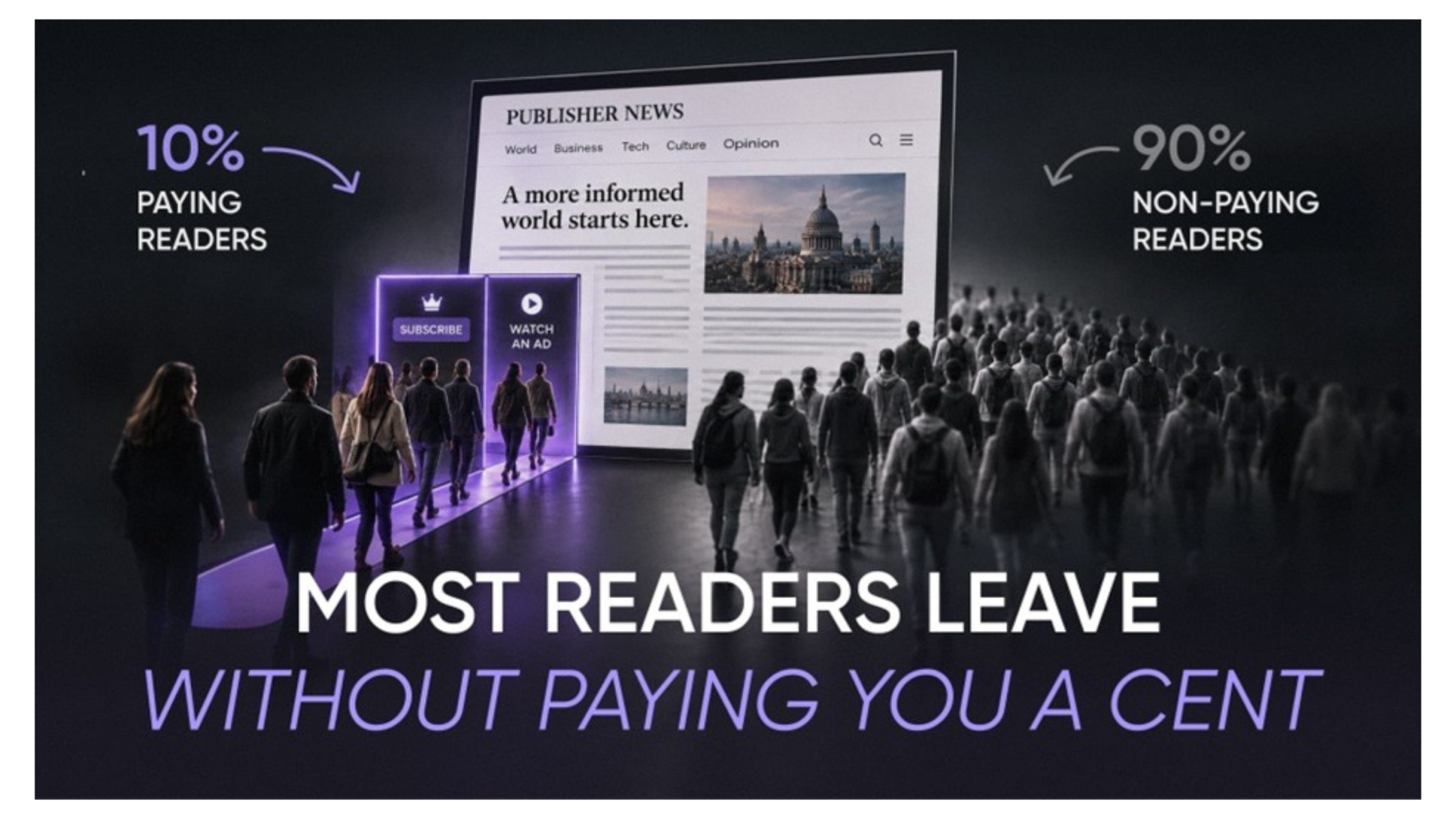
And this is far from a rare exception. Quite the opposite. Roughly 90% of your most loyal readers will never subscribe. Even publishers with highly sophisticated audience conversion strategies rarely manage to convert more than 20% of their audience, and most fall well below that mark. It’s a telling sign that the majority of people who genuinely love what you do still expect to access your content for free. They see that as fair and would rather not have to think about the business model that keeps your publication running.
That leaves publishers with two familiar options: add more banners and ads, or put more content behind paywalls. But there’s another catch. Every additional banner in the sidebar is worth less than the one before it. Display advertising has already pushed CPMs close to their ceiling, while cluttered pages only make the reading experience more frustrating.
Asking readers to subscribe and pay doesn’t necessarily change their minds. In fact, it can trigger resistance. Why, they wonder, has something that used to be free and convenient suddenly become something I have to pay for?
Yet there’s a space between a business model built entirely on display advertising and a subscription wall. What was once seen as a gap in the monetization model is now an opportunity to rethink it altogether. The good news is that readers have another resource they are much more willing to exchange for your content. That resource is their attention.
For decades, media companies operated by one simple mantra: get more traffic. Search engines and social platforms kept sending new pageviews, so publishers focused on capturing readers' attention with a compelling headline or teaser.
But AI Overviews have changed the equation. Click-throughs to publisher websites are declining, and traffic is being cannibalized.
New readers are becoming harder to attract, and every additional stream of traffic costs more to acquire. The economics of publishing are shifting. In our view, the audience publishers already have is one of the most undervalued assets in the industry.
At Membrana Media, we came to a conclusion that sounded almost too simple once we said it out loud: the problem isn't that readers are unwilling to pay. It's the currency they're being asked to use.
People already understand the idea of rewarded advertising. In mobile games, for example, users willingly watch a video ad to unlock another level or earn an extra life. The same principle can work for digital publishing: a reader may not be willing to pay for a subscription, but they might happily watch a short ad to access an article they want to read.
They also choose cheaper, ad-supported streaming plans even when they can afford premium subscriptions. The point is that people aren't necessarily opposed to advertising or unwilling to contribute value. They're more comfortable exchanging their attention than their money in certain situations..
Let's be clear: this isn't about internet users being stingy. It's about a preference for paying with attention rather than money, particularly in moments when that attention is already engaged and ready to be exchanged.
That's the thinking behind our AdWall. A reader reaches premium content and, instead of facing a paywall or another stack of banners, gets a simple offer: watch a short ad to access the article. No tricks, no dark patterns, and no autoplay without consent.
The publisher decides which content sits behind the offer, how many readers see it, and what exactly the exchange unlocks: a single article, a session with fewer ads, or something else entirely.
The key here is clear intent. An ad that a reader actively chooses to watch is worth considerably more to an advertiser than one that simply appears on the side of the page and disappears into banner blindness.
AdWall is designed to reach only a small, selected part of a publisher's audience - typically 5-10%. The rest of the readers continue browsing the site as usual.
Even when the prompt appears, the experience remains in the reader's hands. Site navigation and other sections stay fully accessible, while only the content beyond a designated point in the article is blurred until the reader completes the ad view. Readers can still explore other parts of the website, even if they choose not to watch.
Publishers also have control over how the experience looks and feels. They can customize the modal window to match their publication's design, adjust the message shown to readers, choose where the prompt appears, and set its frequency. The default setting is once every seven days, but this can be tailored to each publisher's strategy.
These settings matter. With a carefully selected audience and a well-designed reader experience, we typically see consent rates of 50–60% and boost CPM to $50.
What if readers simply leave before the video ends? We understand your concern, and the honest answer isn't reassurance. It's testing. Start with a small audience segment, see what actually happens to engagement and abandonment rates, and scale based on real results rather than what someone predicts in a meeting. For most publishers, testing requires just one integration and a single line of code on a test page.
You might also be asking: could this affect subscription revenue? Why pay a monthly fee if you can get free access by watching one video?
But these two offers aren't competing for the same reader. Someone who was already planning to subscribe isn't weighing a subscription against a 30-second video. They'll simply subscribe. AdWall is designed for the much larger group of loyal readers who were never going to pay for a subscription but can still contribute value to the business.
Rewarded advertising doesn't replace subscriptions, and it isn't a reason to abandon banners. Publishers should keep converting every reader they can. But a monetization strategy that has a plan for 1 reader in 10 and little more than a shrug for the other nine is incomplete. And with every passing year, ignoring this loyal audience segment becomes more expensive.
The publishers that will weather the changes ahead and pull ahead over the next few years will build their monetization models not just around traffic (though traffic will always matter), but around their ability to recognize value where reader engagement and loyalty have already been established.